
TL;DR:
- Estate agents in Spain primarily represent the seller, not the buyer, making independent legal counsel essential for protection. Buyers should hire an independent lawyer first, verify agent registration, and avoid signing documents before legal review. Working with an independent buyer agent ensures market access and unbiased support during the property purchase process.
Buying property in Spain feels straightforward until you realize the role of estate agents in Spain is fundamentally different from what American buyers expect. In the US, buyer’s agents legally represent your interests. In Spain, the agent almost always works for the seller. That distinction is not a technicality. It determines who is protecting you, what questions get answered honestly, and whether a costly mistake gets caught before you sign anything. International buyers who miss this difference often pay deposits, sign reservation contracts, and skip legal checks they cannot afford to skip.
Key takeaways
| Point | Details |
|---|---|
| Agents represent sellers | Spanish estate agents are typically hired and paid by the seller, not the buyer. |
| Legal protection requires a lawyer | An independent lawyer handles due diligence and protects your legal interests throughout the purchase. |
| Notaries are neutral officials | The notary verifies formal legality but does not advocate for the buyer’s specific interests. |
| Regulation is improving | Andalusia’s 2026 law mandates registration, training, and insurance for agents, raising professional standards. |
| Hire your lawyer first | Engage an independent lawyer before signing any document or paying any deposit. |
The role of estate agents in Spain’s property market
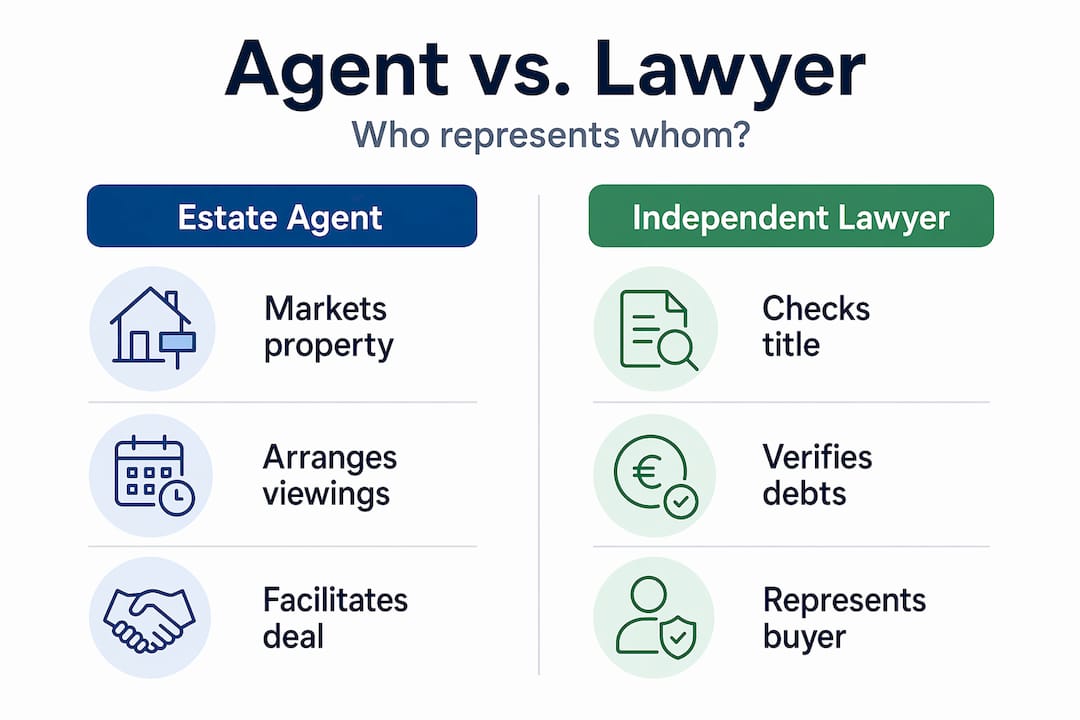
The functions of estate agents Spain buyers encounter cover a defined set of practical tasks. Agents market properties, organize viewings, introduce buyers to sellers, facilitate price negotiations, and coordinate the paperwork trail between the parties. They are transaction facilitators, not legal guardians.
This distinction matters immediately in practice. Agents represent the seller; the buyer has no representation unless they separately hire someone to act exclusively for them. The commission, typically 3% to 5%, is paid by the seller. That financial relationship shapes where an agent’s loyalty sits, regardless of how professional or personable that agent might be.
Understanding what agents actually do helps you use them correctly:
- Property marketing: Agents list properties across portals, manage photography and descriptions, and generate buyer leads.
- Arranging viewings: They coordinate access, accompany buyers on site visits, and explain property features.
- Price negotiation: Agents communicate offers and counteroffers between buyer and seller, working to close the deal.
- Transaction coordination: They gather required documents from the seller, liaise with notaries, and track deadlines.
- Referrals: Many agents refer buyers to lawyers, mortgage brokers, and other professionals, though these referrals come with their own risks.
What agents do not do is conduct title searches, verify outstanding debts on a property, check planning permissions, review contract clauses for legal traps, or act as your advocate if a dispute arises. Many foreign buyers mistakenly assume agents cover these protections, which leads to signing documents and paying deposits before proper checks have been completed.
Pro Tip: Ask any Spanish estate agent directly: “Who do you legally represent in this transaction?” The honest answer should be the seller. If the answer is vague, that tells you something critical about the transparency of the relationship.
Legal roles: agents, notaries, and independent lawyers
One of the most persistent misunderstandings in Spanish property purchases involves the notary. Many buyers assume that because a notary is present at signing, they are somehow protected. The notary’s role is more limited than that.

| Professional | Role | Represents |
|---|---|---|
| Estate agent | Markets property, arranges viewings, facilitates negotiation | Seller |
| Notary | Verifies formal legality of the deed, authenticates signatures | Neither party; a neutral public official |
| Independent lawyer | Conducts due diligence, reviews contracts, protects buyer interests | Buyer exclusively |
| Gestoria | Handles post-purchase admin like tax registration and utilities | Administrative tasks only |
The notary verifies formal legality but does not investigate title history, outstanding mortgages, illegal extensions, or unpaid community fees. Those checks require an independent lawyer who works solely for you. In Spain, unlike the US or the UK, the buyer must actively hire their own legal representation. It does not happen automatically.
The risk of skipping independent legal counsel is concrete. Properties in Spain can carry hidden charges registered against them at the land registry. Planning irregularities on rural properties are more common than many buyers expect. Contracts can contain penalty clauses that heavily favor the seller. None of these issues will be surfaced by an agent whose job is to close the deal.
Pro Tip: Never accept a lawyer referred to you by the selling agent without checking their independence. Agent-recommended lawyers can have referral incentives that compromise where their loyalty sits. Find your lawyer through an independent referral or your own research.
Regulation and professional standards in Spain
The estate agents responsibilities Spain law now requires are evolving, but unevenly across regions. Spain has historically lacked a single national licensing requirement for estate agents, which allowed anyone to operate in the market without formal qualifications. That is changing, most significantly in Andalusia.
Andalusia’s new registration law, effective 2026, mandates that residential agents meet formal requirements before practicing:
- Formal real estate qualifications or equivalent training
- A minimum of four years of professional experience in the sector
- Professional civil liability insurance to protect clients
- A clean criminal record and no financial disqualifications
- Registration on the official Andalusian agent registry
The purpose is to professionalize a sector that has long had a fragmented entry. Professionalization laws are improving standards and building consumer confidence, particularly for international buyers who have no way to assess local agent credibility on their own. The Balearic Islands, which include Mallorca, have their own regulatory framework requiring registration with the Balearic Property Agent Registry, known as RAIBAL. Buyers in Mallorca should verify any agent they work with is properly registered.
These reforms matter because an unregulated market protects no one. When agents operate without insurance or formal training, buyers who suffer losses from negligent advice have limited legal recourse. A registered, insured agent creates an accountability trail that didn’t previously exist.
How to work effectively with agents and lawyers in Spain
Knowing how to choose estate agents in Spain starts before you view your first property. The sequence of professional engagement matters enormously.
- Identify your independent lawyer first. Before you contact any agent, retain a lawyer who has no connection to developers, agencies, or any selling party. Their job is to protect you, and their loyalty must be undivided.
- Use the agent for what they do well. Agents have market knowledge, property access, and negotiation skills. Use them to find properties, understand pricing, and structure an offer. Just don’t confuse that role with legal protection.
- Never sign or pay before legal review. Best practice is having your lawyer conduct full legal due diligence during the reservation phase, before any deposit is paid. This includes checking title at the land registry, verifying no debts or encumbrances exist, and reviewing all contract terms.
- Verify the agent’s registration status. In Mallorca, check RAIBAL. In Andalusia, check the new official registry. A registered agent is a basic bar, not a guarantee of quality, but it filters out the worst actors.
- Consider an independent buyer agent. For international buyers without local networks, a buyer agent who represents only you and has access to properties across all agencies provides a genuine advantage. You get market coverage without the conflict.
The benefits of using estate agents in Spain are real when you use them correctly. They save you time, provide local market intelligence, and handle logistical coordination that would otherwise fall on you. The mistake is expecting them to also handle legal protection. Those are two separate jobs requiring two separate professionals.
Pro Tip: If an agent pushes you to sign a reservation quickly or suggests the lawyer can review “after you secure the property,” treat that as a serious warning sign. Moving too fast before legal checks is one of the most common ways buyers in Spain end up in legally and financially compromised positions.
You can also find a detailed breakdown of common buyer mistakes that cost international purchasers time and money in the Mallorca market specifically.
My perspective on getting this right
I’ve spent years working exclusively with buyers in Mallorca, and the same pattern comes up again and again. Buyers arrive having done their research on the property itself. They’ve checked the area, compared prices, read about the lifestyle. What they haven’t researched is the professional structure around the transaction.
What I’ve seen is that the confusion usually isn’t about distrust of agents. It’s about assuming the system works like it does back home. In the US, the concept of dual agency and buyer representation is embedded in the transaction. You know who your agent is and what they owe you. In Spain, that framework simply doesn’t exist by default. The agent was hired by the seller. The notary is a public official. Nobody in that room is automatically on your side unless you put them there yourself.
The advantage of working with an independent buyer agent like Uli-lisa is not just about access to listings, though full market coverage across all Mallorca agencies is genuinely useful. It’s about having someone whose financial incentives and professional loyalty are aligned with your outcome, not the seller’s. That structural clarity makes every conversation in the transaction more honest.
My strong recommendation: treat the independent buyer agent and the independent lawyer as your core team. Build that team before you fall in love with a property. Once you’re emotionally invested in a specific villa, your negotiating leverage and your willingness to walk away both diminish. Assemble your professionals first.
— Uli
How Uli-lisa supports buyers in Mallorca
Uli-lisa represents buyers exclusively. There are no seller mandates, no referral arrangements with developers, and no commissions from the other side of the table. That independence shapes every recommendation we make.
Our service covers AI-powered property searches across all Mallorca agencies, giving you access to the full market rather than one agency’s limited portfolio. We coordinate negotiations, legal referrals to vetted independent lawyers, and every step from search to signing. For international families and high-net-worth buyers seeking safe property in Mallorca, that structure means you are never navigating an unfamiliar market alone. If you want to understand exactly what independent buyer representation looks like in practice, explore our buyer services to see how we work.
FAQ
What does an estate agent actually do for buyers in Spain?
Estate agents in Spain primarily serve the seller by marketing the property, arranging viewings, and facilitating negotiation. Buyers receive no automatic legal protection from the agent, and should hire an independent lawyer separately.
Who pays the estate agent commission in Spain?
The seller typically pays the estate agent’s commission, which commonly ranges from 3% to 5% of the purchase price. This means the agent’s financial relationship is with the seller, not the buyer.
Does a notary protect the buyer’s interests in Spain?
No. The notary is a neutral public official who verifies that the deed is formally legal, but does not check for hidden debts, planning issues, or contract fairness. Buyers need a separate independent lawyer for that protection.
How do I choose estate agents in Spain as a foreign buyer?
Verify that the agent is registered with the relevant regional registry, such as RAIBAL in the Balearic Islands. Then treat the agent as your market access tool and hire an independent lawyer with no ties to the agent for all legal protection.
What makes an independent buyer agent different from a regular estate agent?
An independent buyer agent represents only the buyer, has no financial relationship with any seller, and can search across all agencies in the market. This removes the conflict of interest that exists when an agent is paid by and loyal to the seller.
Recommended
- Why Choose Real Estate Agent: Complete Mallorca Guide - ULI & LISA Mallorca Property Blog
- Understanding the Role of Real Estate Agents in Mallorca - ULI & LISA Mallorca Property Blog
- Understanding the Role of Real Estate Agents in Mallorca - ULI & LISA Mallorca Property Blog
- Complete Guide to Agent Role in Property Search Mallorca - ULI & LISA Mallorca Property Blog