
TL;DR:
- Buying property in Mallorca offers rewarding investments for high-net-worth individuals but requires understanding local property laws to avoid legal issues.
- The legal framework involves layered regulations from national, regional, and municipal authorities, with registration at the Land Registry being essential for ownership protection.
- Proper due diligence—including obtaining an NIE, verifying documentation, and working with independent legal experts—ensures a secure and compliant property purchase.
Buying property in Mallorca is one of the most rewarding investments a high-net-worth individual can make in Europe. But knowing how to understand local property laws in Mallorca is not optional. It is the difference between a secure acquisition and a costly legal dispute. Mallorca operates under a distinct civil law framework shaped by Spanish national law, Balearic regional legislation, and centuries-old local codes that many foreign buyers never anticipate. This guide walks you through the Mallorca property legal framework, key tax obligations, inheritance rules, and the due diligence steps that protect your capital from day one.
Key takeaways
| Point | Details |
|---|---|
| Get your NIE first | Foreign buyers must obtain a Spanish NIE number before any legal property transaction can proceed. |
| Verify the Nota Simple | Always pull a current Nota Simple from the Land Registry to confirm ownership and outstanding debts before signing anything. |
| Know your tax exposure | ITP transfer tax is assessed on the cadastral reference value, and a valuation gap can trigger a tax audit up to four years later. |
| Inheritance pacts are a real advantage | Mallorca’s medieval succession laws allow qualifying residents to transfer assets during their lifetime with significant tax benefits. |
| Independent representation matters | A buyer agent with full market access catches illegal builds, unregistered encumbrances, and negotiation leverage that seller agents will not disclose. |
How to understand local property laws in Mallorca
Mallorca’s property legal framework is built on three overlapping layers. Spanish national law governs the fundamentals of property ownership, mortgage registration, and notarial procedure. Balearic regional law adds local tax rules, environmental protections, and coastal regulations. Finally, each municipality enforces its own urban planning codes, which determine what you can build, renovate, or operate commercially on any given plot.
The Land Registry, known as the Registro de la Propiedad, is the cornerstone of legal property ownership in Mallorca. Registration is not automatic. Once you complete a purchase, the title deed must be formally inscribed at the registry, which creates a public record of your ownership rights and any encumbrances on the property.
Before you reach that stage, the Nota Simple is the document every serious buyer must obtain. This registry extract confirms the current legal owner, lists any mortgages, easements, liens, or community debts attached to the property, and details the registered surface area. Discrepancies between the Nota Simple and what you are shown physically are a red flag that warrants investigation, not negotiation.
Key mandatory steps for foreign buyers before entering any purchase contract include:
- Obtaining a NIE (Número de Identificación de Extranjeros), without which no purchase can legally proceed
- Requesting a current Nota Simple directly from the Land Registry or through a solicitor
- Confirming the property’s urban classification under the local municipal plan
- Checking whether any tourist rental license is attached to the property, since licenses are capped in Palma and Ibiza with no new ones being issued
Pro Tip: Apply for your NIE at the Spanish consulate in your home country before traveling to Mallorca. Processing times inside Spain can add weeks to your timeline and delay your purchase contract signing.
The legal steps for buying property in Mallorca
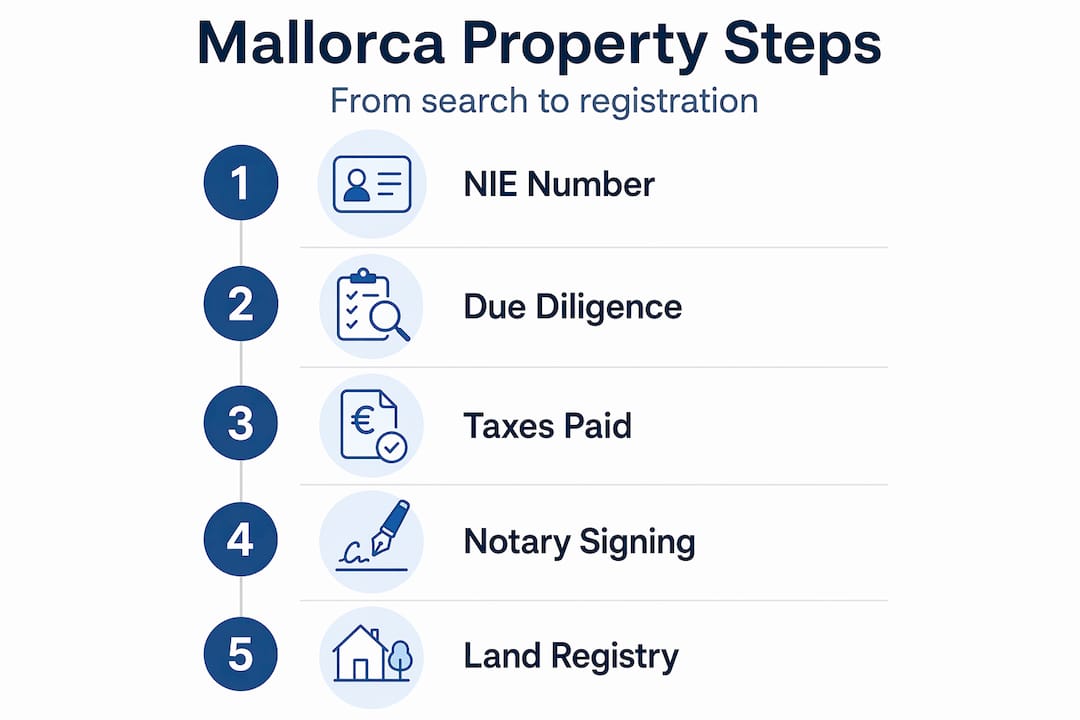
The Mallorca property purchase process follows a defined sequence, and shortcutting any step creates legal exposure. Here is the order that every foreign buyer should follow:
- Engage a buyer’s solicitor independently of the selling agent. Your lawyer’s job is to protect your interests, not close the deal. They will conduct all legal checks before you commit funds.
- Run full pre-purchase due diligence. This includes reviewing the Nota Simple, confirming planning permissions, checking building licenses, and commissioning a structural survey. Qualified surveyors verify that the property’s physical characteristics match the registry records and uncover any illegal renovations.
- Sign the private purchase contract (Contrato de Arras). This is a binding reservation contract where you typically deposit 10% of the purchase price. Withdrawing after this point forfeits your deposit.
- Complete the notarial deed (Escritura de Compraventa). Spanish law requires all parties to appear before a notary public to execute the final deed. The notary verifies identities, reads the deed aloud, and witnesses the transfer.
- Pay all taxes within 30 days. Failure to do so triggers penalties and interest from the Balearic Tax Authority.
- Register the title deed at the Land Registry to protect your ownership publicly.
“The notary in Spain does not represent the buyer or the seller. They represent the Spanish state. Never assume the notary’s presence means your legal interests are protected. That is your solicitor’s role, not the notary’s.”
Regarding taxes, the primary cost for resale properties is the Impuesto de Transmisiones Patrimoniales (ITP), which is the transfer tax. New builds from developers attract VAT instead. Stamp duty applies to both. Each tax has a specific rate and deadline, and getting these calculations wrong creates liability that follows you for years.
Tax obligations every Mallorca buyer must know
Understanding your tax exposure is one of the most critical aspects of knowing how to navigate Mallorca property laws. The stakes are high, and the rules have changed significantly in recent years.

| Tax | Who Pays | Rate / Basis | Key Risk |
|---|---|---|---|
| ITP (Transfer Tax) | Buyer (resale property) | 8–11% on cadastral reference value | Tax audit if valuation and price differ |
| VAT (New Build) | Buyer (new development) | 10% (reduced rate) | Must verify developer’s tax status |
| Stamp Duty (AJD) | Buyer | 1.2% of deed value | Applies alongside VAT on new builds |
| Non-Resident Income Tax | Non-resident owners | 1.1% of cadastral value annually | Applies even without rental activity |
| IBI Municipal Tax | All owners | €500–3,000 annually | Confirmed at point of sale |
Since 2022, the ITP tax base is primarily assessed on the cadastral reference value. When no cadastral reference value exists, the tax authority uses the highest of the declared value, the actual purchase price, or the estimated market value. The gap between what you declare and what a bank valuation shows can trigger a formal tax check. Under 2024 and 2026 court rulings, tax authorities can initiate these checks without prior evidence of fraud, and they can look back up to four years after the transaction closes.
For non-residents, the Non-Resident Income Tax applies to deemed rental income even if you never rent the property. The calculation is based on 1.1% of the cadastral value, taxed at 19% for EU residents and 24% for non-EU nationals.
Pro Tip: Engage a Spanish tax adviser before you sign the purchase contract, not after. Early review of the cadastral value against the agreed purchase price lets you preempt ITP tax checks and structure the transaction to reduce your legal exposure.
One genuinely underreported benefit: since 2023, the Balearic government eliminated inheritance and gift taxes for immediate family members. Spouses, children, and parents now benefit from a 100% exemption. For estate planning purposes, this changes the math significantly.
Mallorca’s medieval inheritance laws explained
This is the section of Mallorca’s legal framework that most international buyers discover too late. Mallorca operates under a historic civil law tradition that includes pactos sucesorios, or inheritance pacts. These are legally binding agreements that allow asset transfer during the owner’s lifetime rather than through a will executed after death.
The practical significance of this is enormous:
- Inheritance pacts allow you to transfer Mallorca property to your heirs now, at today’s value, avoiding probate delays and potential estate tax complications in your home country.
- They are not available under most national legal systems, which is why Mallorca attracts buyers specifically for this mechanism.
- Following Law 8/2022, these succession pacts were extended to habitual foreign residents, not just Spanish nationals.
- When combined with the 2023 inheritance tax exemption for immediate family, the tax saving over a traditional estate structure can be substantial.
| Succession Method | Available To | Tax Position | Timing of Transfer |
|---|---|---|---|
| Standard will | All buyers | Standard probate rules | After death |
| Inheritance pact (pacto sucesorio) | Habitual residents | 100% exemption for family | During lifetime |
| Gift inter vivos | All buyers | 100% exemption for family (since 2023) | During lifetime |
Mallorca’s unique civil law system creates legally sophisticated tools that most buyers from common law countries like the United States never encounter. Working with an adviser who understands both Balearic civil law and cross-border succession rules is not a luxury. It is a prerequisite for serious estate planning.
Common legal pitfalls when buying in Mallorca
Knowing the Mallorca property legal framework matters, but avoiding specific traps matters just as much. Here are the most common mistakes that cost buyers money and time:
- Buying without verifying building licenses. Mallorca has a meaningful number of properties with unauthorized extensions, converted outbuildings, or renovations done without permits. If those structures are illegal, they become your legal problem the moment you take title.
- Skipping the structural survey. A Nota Simple tells you the legal status of the property. It does not tell you whether the roof is sound, the electrical wiring is compliant, or the pool is registered. Building inspections by qualified surveyors are the only way to confirm what you are physically buying matches what the documents describe.
- Assuming the seller’s agent protects your interests. A selling agent is paid by the seller. Their legal obligation runs to the vendor, not to you. This is not a criticism. It is simply how the system works, and understanding it changes how you structure your team.
- Missing tourist rental license compliance. If you plan to generate rental income, you need a valid existing license. Licenses are capped across the Balearic Islands, and you can review the rental license requirements before making any assumptions about income potential.
- Failing to account for community of owners rules. Properties in urbanizations or apartment complexes are subject to community bylaws that may restrict rentals, renovations, or even exterior modifications. Read those documents before signing.
Pro Tip: When you verify property documents in Mallorca, always cross-reference the Nota Simple, the building license, the community statutes, and the municipal planning register. Any single document in isolation gives you an incomplete picture.
Independent buyer agents with full market access provide a structural check against these risks. They can negotiate price adjustments based on identified legal issues and have no incentive to push through a deal that does not serve your interests.
My perspective on legal due diligence in Mallorca
I have worked with high-net-worth international buyers across Mallorca’s most complex transactions, and I will tell you what most buying guides will not. The biggest legal mistakes I see are not made by buyers who ignored the rules. They are made by buyers who trusted the wrong people to enforce them.
In my experience, sellers in Mallorca are not typically dishonest. But they often do not know the full legal status of their own property. An unauthorized terrace added fifteen years ago is just “the terrace” to them. To the tax authority or the local urban planning department, it is a liability that transfers with the deed.
What I have learned from representing clients through these transactions is that early legal engagement, before the emotional attachment sets in, produces dramatically better outcomes. When you fall in love with a property first and do the legal checks second, you lose negotiating leverage and compromise your judgment.
I also want to be direct about one thing: the Mallorca property market rewards buyers who understand the local legal framework. The buyers who do the work, get independent representation, and treat legal due diligence as a non-negotiable filter consistently make better acquisitions at better prices.
— Uli
How Uli-lisa protects your Mallorca property investment
At Uli-lisa, we represent buyers exclusively. That means our entire process, from property search to legal coordination to final negotiation, is structured to protect your capital, not to close a commission. We combine full market access across every Mallorca agency with hands-on legal due diligence support, including cadastral value analysis, document verification, and coordination with independent tax advisers.
If you are buying in Mallorca and want to understand exactly where your legal exposure lies before you commit, we can help you buy property safely with the legal clarity that serious investors require. We work with American buyers navigating the property legal process in Mallorca every day, and we know where the risks hide.
FAQ
What does a Nota Simple tell you about a Mallorca property?
A Nota Simple from the Land Registry confirms the legal owner, lists any mortgages or liens, and shows registered surface area. It is the first document any buyer should request before proceeding.
Do foreign buyers in Mallorca need a NIE number?
Yes. A NIE is legally required for all property transactions in Spain, and without it no purchase contract or notarial deed can be executed. Apply through a Spanish consulate before traveling when possible.
How does the ITP transfer tax work in Mallorca?
ITP applies to resale property purchases and is assessed primarily on the cadastral reference value since 2022. Rates range from 8% to 11%, and a significant gap between the declared price and an official bank valuation can trigger a tax audit up to four years after closing.
Can foreign buyers use Mallorca’s inheritance pacts for estate planning?
Yes. Following Law 8/2022, habitual foreign residents in Mallorca can use inheritance pacts to transfer property during their lifetime. When combined with the 2023 inheritance tax exemption for immediate family, this creates a highly efficient cross-border estate planning tool.
What is the non-resident income tax on Mallorca property?
Non-resident owners pay an annual income tax on deemed rental income calculated at 1.1% of the cadastral value, taxed at 19% for EU residents and 24% for non-EU nationals, regardless of whether the property is actually rented out.
Recommended
- Navigate Mallorca property laws: guide for U.S. buyers - ULI & LISA Mallorca Property Blog
- Coastal Property Regulations Mallorca: What U.S. Investors Need - ULI & LISA Mallorca Property Blog
- Mallorca Rental Laws Explained: Secure Legal ROI for Investors - ULI & LISA Mallorca Property Blog
- Complete Guide to Mallorca Property Search - ULI & LISA Mallorca Property Blog