
TL;DR:
- U.S. investors must verify Mallorca property documents to avoid costly tax and legal errors.
- The comparison method is mandatory for valuation when sufficient sales data exists.
- Premium features like sea views and pools significantly increase property value and should be documented.
Mallorca’s luxury property market rewards precision. American investors who skip the compliance groundwork or rely on rough online estimates often discover, too late, that Spanish valuation rules operate on an entirely different logic than back home. A misread cadastral value can inflate your tax bill by tens of thousands of euros. An overlooked rental license gap can erase projected yield overnight. This guide walks you through every critical step: the compliance documents you must verify, the three core valuation methods used under Spanish law, the specific features that add measurable premiums, and the strategies to challenge an inflated assessment before it costs you.
Key Takeaways
| Point | Details |
|---|---|
| Check compliance first | Verifying legal and tax documents before valuation avoids expensive surprises. |
| Select the right valuation method | Use the comparison approach when possible and understand when cost or income methods apply. |
| Quantify premium features | Features like sea views or a pool can increase value by up to 50 percent. |
| Defend your assessed value | Have supporting reports ready to challenge excessive tax or cadastre assessments. |
Essential documents and compliance checks
Before any valuation can be trusted, the legal foundation of the property must be solid. In Mallorca, this means gathering a specific set of documents that reveal encumbrances, tax liabilities, and regulatory status. Many U.S. investors skip this step, assuming a clean listing means a clean title. That assumption is expensive.
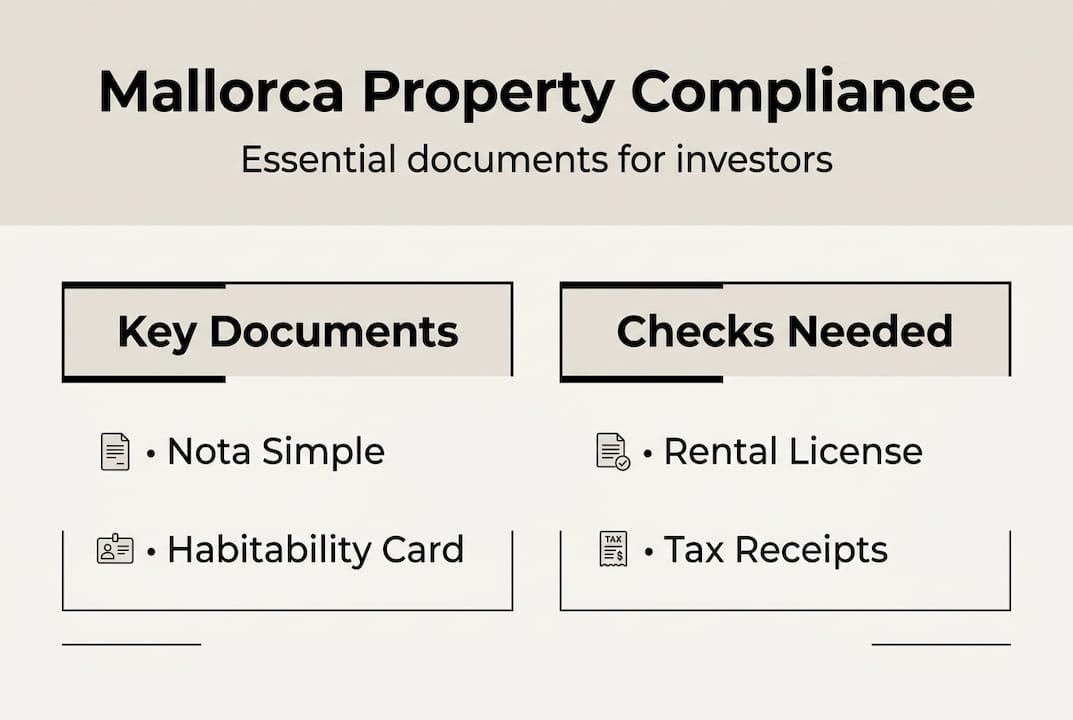
Here are the core compliance documents every buyer must review:
- Nota Simple: Issued by the Land Registry, this document shows ownership history, registered encumbrances, mortgages, and easements. It is the first thing any serious buyer should request.
- Cédula de Habitabilidad: The habitation certificate confirms the property legally qualifies as a residence. Without it, you cannot connect utilities or legally occupy the home.
- IBI arrears: IBI is the annual local property tax. Unpaid IBI stays with the property, not the seller, meaning you inherit the debt at closing.
- ETV rental license: If you plan to generate income, you need an Estancia Turística en Vivienda license. These are tightly regulated and, in many coastal zones, no longer issued for new properties.
For U.S. buyers specifically, two additional compliance layers matter. First, non-resident income from Spanish property is taxed at 24% IRNR, Spain’s non-resident income tax. Second, the Impuesto de Transmisiones Patrimoniales (ITP), the property transfer tax, runs in bands: 8% up to €400,000, 9% between €400,000 and €600,000, and 10% above €600,000. You also have the right to challenge the cadastral reference value if it exceeds true market value, which directly affects your tax base.
| Document | Purpose | Where to obtain |
|---|---|---|
| Nota Simple | Ownership, debts, encumbrances | Land Registry (online or notary) |
| Cédula de Habitabilidad | Legal habitability status | Local town hall (Ajuntament) |
| IBI receipt | Confirm no tax arrears | Seller or local tax office |
| ETV license | Rental income eligibility | Govern de les Illes Balears |
| Cadastral certificate | Tax base reference value | Catastro (online portal) |
Understanding holiday rental license requirements in Mallorca is especially important for high-yield investment strategies. Avoid the common legal mistakes that trip up foreign buyers by having every document reviewed by a local gestor or independent legal advisor before signing anything.
Pro Tip: Never rely on the seller’s copies alone. Pull the Nota Simple yourself directly from the Land Registry. It costs under €10 and gives you an unfiltered, real-time picture of the property’s legal status.
Understanding the main property valuation methods
Once your compliance documents are in order, the next step is selecting the right valuation method. Spain’s ECO Order (Ministerial Order ECO/805/2003) governs how certified appraisers must value real estate. Three approaches are recognized, and each has a different application depending on the property type and your investment goals.
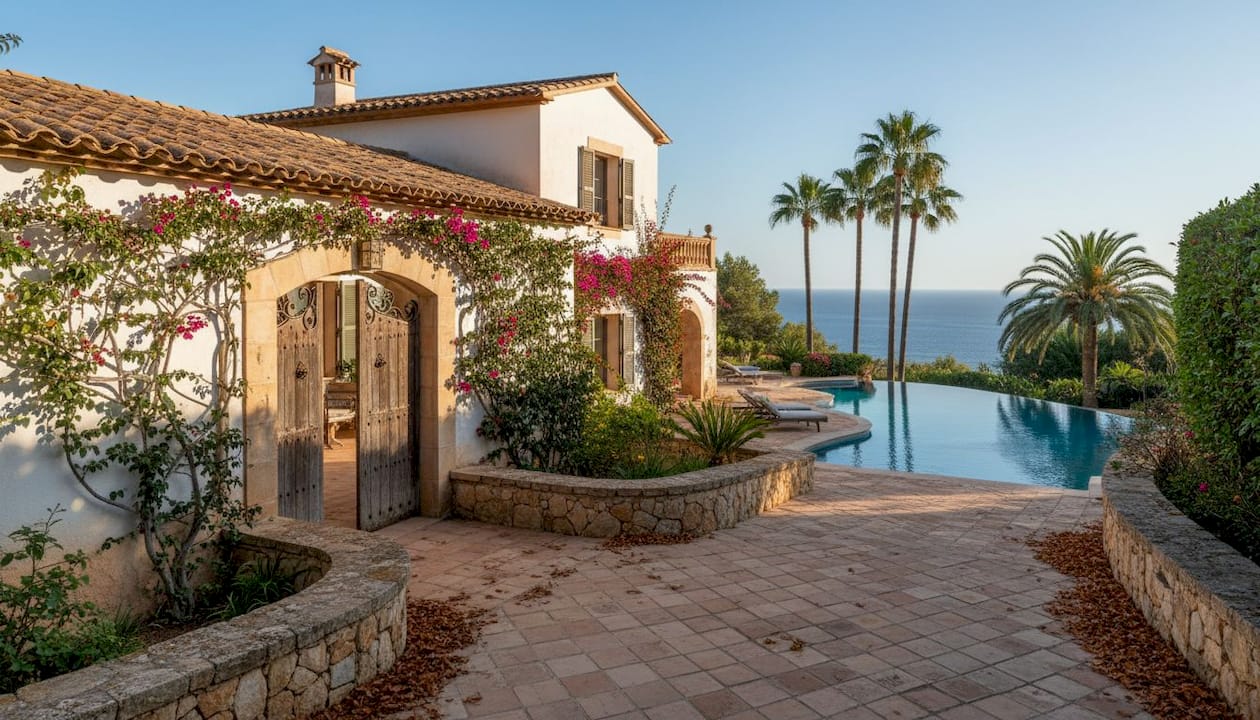
The comparison (sales comps) approach is the primary method and is mandatory under Spanish ECO Order whenever sufficient comparable sales data exists. Appraisers identify at least six comparable transactions, then apply coefficient adjustments for differences in features. A sea view, for example, can carry a coefficient adjustment of up to +15% in formal appraisals. This method is closest to what U.S. investors recognize from domestic real estate practice, but the adjustment methodology is more rigidly structured in Spain.
The cost approach calculates value as land value plus construction costs minus depreciation. It is most useful for new builds, custom fincas, or properties with limited comparable sales. The challenge in Mallorca is that land values in prime coastal zones are highly subjective, and construction cost databases can lag behind actual market rates.
The income (capitalization) approach divides stabilized net operating income by a market cap rate to arrive at value. This method is preferred for income-generating assets in prime locations. For a licensed villa in Puerto Andratx or Deià generating consistent short-term rental income, the income approach often produces the most defensible number for investment underwriting.
Review the full valuation methods overview and the property valuation process Mallorca for deeper context on how each method is applied locally.
| Method | Best use case | Pros | Cons |
|---|---|---|---|
| Comparison (comps) | Resale villas, apartments | Market-reflective, ECO-compliant | Requires recent, comparable sales |
| Cost approach | New builds, rural fincas | Useful where comps are scarce | Land value subjectivity |
| Income (cap rate) | Licensed rental properties | Strong for investment underwriting | Depends on reliable income data |
Pro Tip: For U.S. investment underwriting, pair the income approach with a certified mortgage appraisal using the comparison method. The two together give you both a regulatory-compliant value and a yield-based investment justification.
Key factors that drive luxury property value
Valuation methods provide the framework, but specific asset features and market dynamics determine where a property actually lands within that framework. In Mallorca’s luxury segment, certain attributes carry measurable, quantifiable premiums that you can use to stress-test any appraisal you receive.
The top five value drivers in Mallorca luxury real estate:
- Location tier: Proximity to Palma, established port towns like Puerto Pollença or Puerto Andratx, and exclusive rural zones like Valldemossa each command distinct price bands.
- Views: Sea views are the single most powerful premium driver in the market.
- Amenities: Infinity pools, home automation, wine cellars, and private tennis courts all add measurable value.
- Build quality and architecture: Certified sustainable builds, designer interiors, and licensed renovations command higher appraised values.
- Lot size and privacy: Large plots in areas with building restrictions are increasingly scarce and carry scarcity premiums.
The numbers behind these premiums are significant. Sea views add 18.8% on average to market value, while a pool adds between 40% and 50%. When you combine a sea-view plot with a licensed pool and a valid ETV rental license, the cumulative premium effect can push a property well above its base cadastral reference value.
Several factors are unique to the Mallorca and broader Spanish context:
- Tourism license eligibility varies sharply between rural and urban classifications
- Coastal law (Ley de Costas) restricts modifications within 100 meters of the shoreline
- Rural finca classifications limit new construction and can affect resale liquidity
- ETV licenses in moratorium zones are now tradeable assets in themselves, sometimes valued at €50,000 or more
For U.S. investors, these factors intersect directly with the three investment criteria that matter most: rental yield, capital appreciation, and liquidity. A property with a valid ETV license in a high-demand coastal zone checks all three boxes. A rural finca without a license, regardless of its beauty, may score poorly on liquidity. Reviewing the factors affecting valuation in detail will help you build a weighted scoring model for any property you are evaluating.
Strategies for confirming and defending your assessed value
Knowing what drives value is only useful if you can verify the number you are given and push back when it is wrong. In Mallorca, cadastral reference values are frequently overstated relative to actual market prices, which inflates your ITP transfer tax base and ongoing IBI liability.
Here is a step-by-step process for verifying and defending your assessed value:
- Commission a certified mortgage appraisal. A bank-certified tasación from an ECO-compliant appraiser is the most credible document for both financing and tax dispute purposes.
- Obtain an independent expert valuation report. This is separate from a bank appraisal and can be prepared by a certified real estate expert (perito). It carries weight in administrative appeals.
- Request comparative transaction data from independent agents. Agents with deep local market access can provide recent closed sales data that supports or contradicts the cadastral value.
- File a formal challenge if the cadastral value exceeds market. Submit your appraisal and expert report to the Agencia Tributaria as evidence. The burden of proof shifts once you provide documented market evidence.
The ITP tax structure makes this challenge worth pursuing for high-value acquisitions. As a reference:
ITP transfer tax rates in 2026: 8% on the first €400,000, 9% on €400,000 to €600,000, and 10% above €600,000. Non-resident buyers typically face a loan-to-value cap of 60% to 70%. IBI annual property tax runs between 0.4% and 1.1% of cadastral value depending on the municipality.
For U.S. buyers navigating Mallorca tax strategies and real estate taxes, understanding these rates in advance allows you to model your true acquisition cost before making an offer.
Pro Tip: Time your cadastral challenge before the ITP payment deadline. Once you pay the tax based on the overstated value, recovering it requires a separate refund claim, which is slower and less certain than a pre-payment challenge.
Our perspective: Avoiding costly Mallorca valuation mistakes
After working with American buyers across many Mallorca transactions, one pattern stands out: most valuation errors do not come from bad math. They come from trusting a single source. Agency-provided appraisals have an obvious conflict of interest. Online comp tools pull from listing prices, not closed transactions. Neither gives you the full picture.
What actually protects you is multidisciplinary validation. A local legal advisor reviews the compliance documents. An independent certified appraiser applies the ECO methodology. A tax advisor models your IRNR exposure and ITP liability. And an independent buyer agent, with no stake in the transaction price, cross-checks all of it against real market data.
Coastal law restrictions, ETV license moratoriums, and rural classification rules can override even a perfectly executed valuation model. We have seen buyers pay a 15% sea-view premium for a property where the view was legally at risk from a pending coastal development permit. The math was right. The due diligence was not.
Avoid the Mallorca buyer mistakes that cost investors real money by insisting on verified documentation for every premium feature before you accept any appraised value as final.
Pro Tip: Always confirm that sea views, pools, and tourism licenses are formally registered and not just physically present. An unregistered pool or an unlicensed rental operation creates liability, not value.
Next steps: Expert guidance for confident property investment
Putting all of this into practice requires local expertise that bridges two worlds: U.S. investment standards and Spanish regulatory reality. As independent buyer agents based in Mallorca, ULI & LISA specialize in exactly this intersection. We run AI-powered property searches across the full market, not just listed inventory, and we coordinate compliance checks, valuation reviews, and tax modeling for American clients. Whether you need a full property audit before making an offer or want to understand how a specific asset’s features translate into defensible value, our safe property investment process and luxury property services are built for buyers who need precision, not guesswork.
Frequently asked questions
What is the mandatory property valuation method in Mallorca?
The comparison approach using sales comps is mandatory under Spanish ECO Order whenever sufficient comparable transaction data is available. Other methods are used only when comps cannot be reliably sourced.
How do sea views or pools affect Mallorca property value?
Sea views add 18.8% on average to market value, and a pool typically adds between 40% and 50%. Combined with a valid rental license, these features can significantly exceed their individual premium contributions.
Which compliance documents must U.S. investors check?
You must review the Nota Simple, Cédula de Habitabilidad, current IBI payment receipts, and any required ETV rental license before proceeding with a purchase or valuation.
Can I challenge the cadastral reference value for my property?
Yes. You can contest an overstated cadastral value by submitting a certified mortgage appraisal or an independent expert report to the Spanish tax authority as formal evidence.
Recommended
- How to Assess Mallorca Property Value for Americans - ULI & LISA Mallorca Property Blog
- How to Evaluate Mallorca Real Estate: A Comprehensive Guide - ULI & LISA Mallorca Property Blog
- How to Evaluate Mallorca Real Estate: A Comprehensive Guide - ULI & LISA Mallorca Property Blog
- How to Negotiate Property Price Mallorca: A Complete Guide - ULI & LISA Mallorca Property Blog